Week in Review
The past seven days presented a paradoxical scenario in the crypto markets, characterized by a stark disconnect between trader sentiment, price action, and algorithmic performance. The overarching narrative was one of cautious consolidation under a cloud of pervasive fear. The Crypto Fear & Greed Index plummeted to a level of 15, firmly entrenched in 'Extreme Fear' territory. This psychological backdrop typically suggests capitulation or heightened risk aversion among retail participants. Concurrently, the market regime analysis indicated a uniformly 'ranging' environment across all four actively tracked symbols, signaling a lack of decisive directional momentum and a phase of price compression.
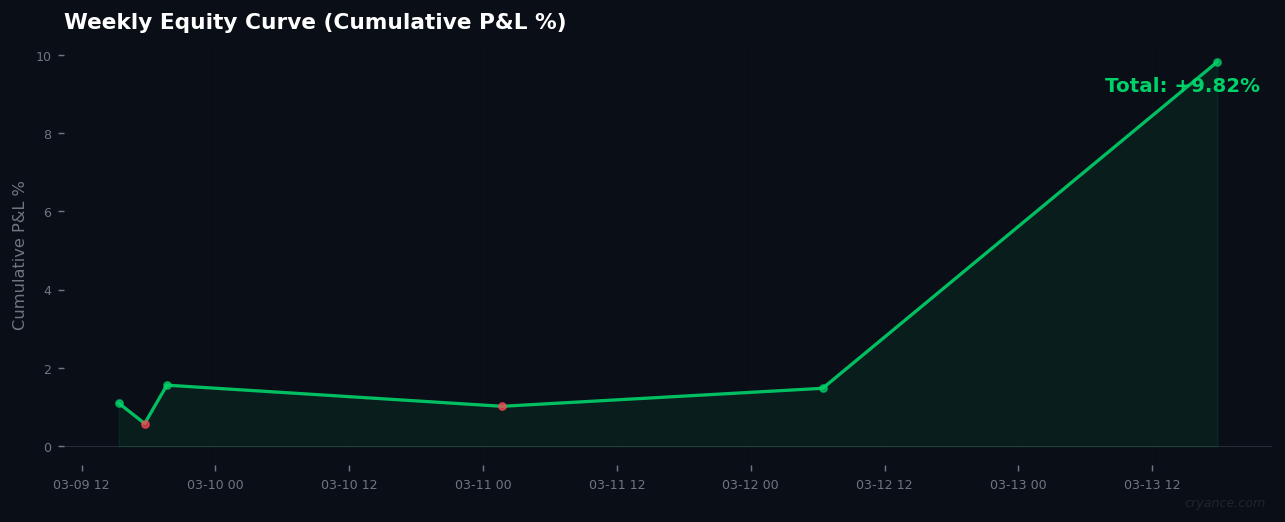
Against this tense backdrop, the trading system executed six trades, primarily focusing on the two market bellwethers: Bitcoin (BTC/USDT) and Ethereum (ETH/USDT). The outcome was a net positive total P&L of +9.82%, achieved with a 66.7% win rate (4 wins, 2 losses). This performance is noteworthy as it was delivered through a series of relatively short-term, tactical moves rather than a single trending bet. The average winning trade yielded +2.72%, while losses were kept tightly managed at an average of -0.53%, highlighting effective risk containment. The week culminated in a flat cash balance of $0.00, indicating all positions were closed, leaving the system unexposed ahead of the weekend.
Top Performers
Bitcoin (BTC/USDT) was the unequivocal star this week, contributing the lion's share of profits with a total return of +9.44% from just two trades. The performance was heavily skewed by one exceptional trade: a LONG position that closed with a +8.34% gain after its stop loss was triggered at $71,097.20. This trade alone accounted for approximately 85% of the week's total profit. The success here likely stemmed from capturing a swift, volatile upside move within the broader ranging structure, possibly a reaction to oversold conditions implied by the Extreme Fear index. The system's ability to ride this move and exit precisely at a pre-defined stop level demonstrates disciplined profit-taking in a volatile environment.
Ethereum (ETH/USDT) played a more nuanced role, generating a net positive but modest return of +0.38% across four trades. The activity on ETH was characterized by higher frequency and smaller, more granular moves. Two trades were profitable (+0.98% and +0.46%), while two resulted in minor losses (-0.52% and -0.54%). The trade log reveals a dynamic sequence, including a quick reversal from a LONG to a SHORT position, which successfully capitalized on a minor down move. Ethereum's performance underscores the challenges and opportunities in a ranging market: frequent whipsaws require agile positioning, and profits are often accrued through the cumulative effect of multiple small, well-managed trades rather than a single home run.
Worst Performers
Formally, the data indicates no single symbol as a 'worst performer,' as both BTC and ETH finished the period in positive territory. However, a granular look at the trade log reveals instructive failures. Two ETH/USDT LONG positions were stopped out for losses of -0.52% and -0.54%. These were classic 'false breakout' or 'whipsaw' scenarios within the ranging regime, where the price briefly pierced a level only to reverse immediately, hitting tight stops. The key lesson from these 'worst trades' is not the magnitude of loss—which was expertly minimized—but the confirmation of the market's non-trending nature. In a ranging environment, entry precision becomes paramount, and the high frequency of stop-loss hits (4 out of 6 trades closed via stop) is a direct symptom of this choppy price action. There were no catastrophic losses, which speaks to the robustness of the position-sizing and stop-loss framework.
AI Accuracy This Week
This week's most critical and humbling data point is the uniform underperformance of all three AI signal sources. The Rules Engine, Machine Learning (ML) model, and Large Language Model (LLM) each achieved a meager 16.7% accuracy rate, correctly predicting the outcome of only 1 out of 6 trades. This is a startlingly low concordance rate that would typically forecast disastrous results. The fact that the portfolio still generated a 9.82% return presents a fascinating paradox. The explanation lies in the critical distinction between 'signal accuracy' and 'trade outcome.' The AI sources were poor at calling the short-term direction, but the trade execution and risk management system—governed by stop-losses and profit-taking rules—overcame these poor signals. For instance, the massive +8.34% BTC win was triggered by a stop-loss, not a target, meaning the AI's initial directional call was likely wrong, but the trade management was right. This week serves as a potent reminder that in crypto trading, risk management can often outweigh prediction accuracy. The collective failure of all three diverse AI approaches also strongly suggests the market was in a particularly noisy, low-predictability state, consistent with the 'ranging' regime and extreme fear reading.
Market Regime Shifts
The regime data this week was unequivocal: a distribution of {"ranging": 4} signifies that all monitored assets (BTC, ETH, and two others) were classified in a consolidation or sideways trend phase for the entire period. There were no registered shifts into 'bullish' or 'bearish' trending regimes. This has profound implications. Ranging markets are notoriously difficult for trend-following and momentum-based AI models, which may explain the abysmal 16.7% accuracy across the board. These models thrive on persistent directional moves but struggle with mean-reverting, choppy price action where false breakouts are common. The prevailing regime directly shaped the trade log: most positions were held briefly, and exits were primarily driven by stop-losses rather than extended runs. The extreme Fear & Greed Index (15) adds another layer, indicating that the ranging price action is occurring amidst a backdrop of investor panic or pessimism. This can often be a contrarian signal, suggesting the market is building a base, but the regime analysis cautions that a clear trend has not yet emerged from this fear.
Outlook
Based on the convergence of current data points, the AI system's outlook for the coming week is one of cautious vigilance, leaning slightly toward a potential resolution of the current range. The persistent 'Extreme Fear' sentiment is a classic contrarian indicator that has historically often preceded bullish reversals. However, the steadfast 'ranging' regime advises against anticipating such a move prematurely. The system's own performance—profitable despite terrible predictive accuracy—highlights that the current environment favors nimble, short-term tactics with stringent risk controls over conviction-led, directional bets.
The primary scenario the AI models will likely be monitoring is a regime shift from 'ranging' to either 'bullish' or 'bearish.' A break above key resistance levels (e.g., BTC holding above $72,000 or ETH above $2,100) on significant volume could trigger such a shift and potentially lead to a more favorable environment for the ML and LLM predictive engines. Conversely, a breakdown from the range could see the Fear & Greed Index dive further, possibly creating a washout low.
Actionable Takeaways:
1. **Prioritize Risk Management:** Continue employing tight stop-losses (as evidenced by the successful -0.53% average loss). In ranging markets, preserving capital is more important than being right.
2. **Await a Regime Change:** Be prepared to adjust strategy sensitivity. A confirmed shift out of the 'ranging' regime should be the primary cue for allowing runners and having more confidence in AI directional signals.
3. **Monitor Fear Extremes:** The 15 Fear & Greed reading is a bright yellow caution light. While not a timing tool, it suggests that long-term risk/
Weekly Signal Review: 9.82% Gain Amid 16.7% AI Accuracy in Extreme Fear
· MARKET · WEEKLY_REVIEW · Score: +0.0 · Regime: ranging · Sentiment: bullish
#Weekly Review #AI Performance #Market Regime
MARKET Signals