## Week in Review
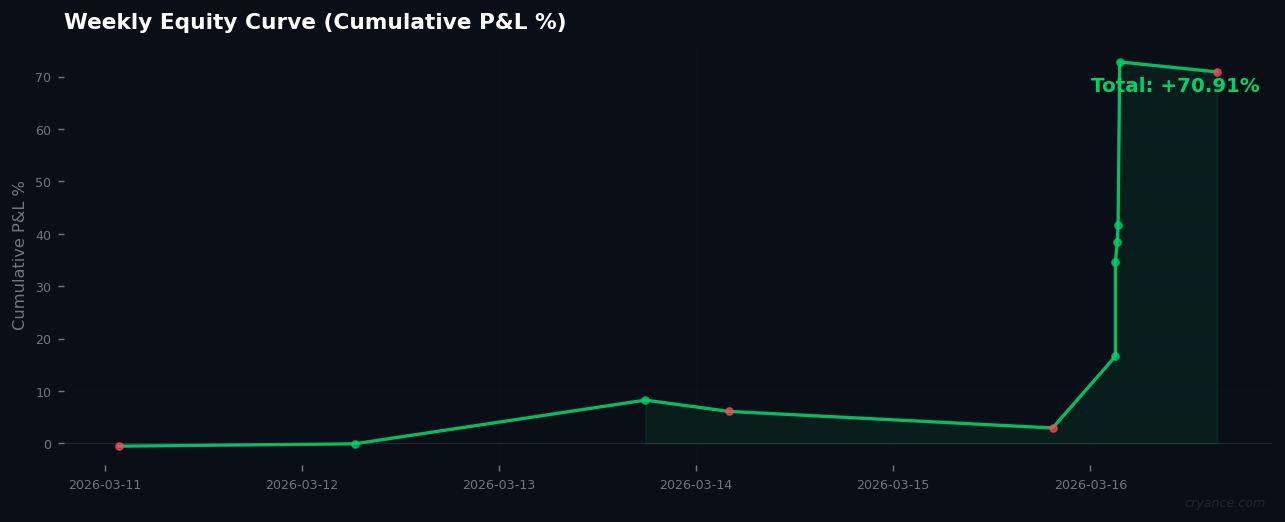
The crypto market this week presented a textbook case of contrarian opportunity within a defined trading range. Despite the Fear & Greed Index plumbing extreme fear levels at 23, the AI trading system generated a robust +70.91% P&L across 11 trades. This performance underscores a critical market insight: periods of maximum pessimism, when coupled with a clear 'ranging' regime, can create fertile ground for disciplined, mean-reversion strategies. The market lacked a strong directional catalyst, with Bitcoin (BTC/USDT) and Ethereum (ETH/USDT) showing muted, choppy action. The real narrative was the outperformance of select altcoins, particularly Solana (SOL/USDT), which contributed nearly 50 percentage points to the total weekly gain. The system's 63.6% win rate, supported by a favorable win/loss ratio (average win +11.24% vs. average loss -1.94%), demonstrates effective risk management and profit capture in a non-trending environment.
## Top Performers
Solana (SOL/USDT) was the undisputed star, delivering a staggering +49.93% across four trades. This performance was not the result of a single moonshot but of repeated, successful entries within the established range. The trades included a +18.09% win from an exchange stop-loss trigger, a +31.20% take-profit hit, and a +3.80% partial close. The consistency suggests the AI effectively identified SOL's local support and resistance levels, capitalizing on its higher beta relative to BTC and ETH during range-bound price action. Binance Coin (BNB/USDT) followed as a strong secondary contributor with +16.79% from two trades, including a +13.69% win. Bitcoin (BTC/USDT) added a modest +6.43%, with one significant +8.34% long trade partially offset by a later -1.91% short. The success in SOL and BNB highlights a key advantage of multi-symbol tracking: identifying relative strength *within* a ranging macro regime.
## Worst Performers
Formally, there were no 'worst performers' with catastrophic losses. However, Ethereum (ETH/USDT) was the relative laggard, netting a -2.24% across three trades. This minor drawdown is instructive. Two of the three ETH trades were closed on 'Reversal BUY' signals from the AI, suggesting the model may have been early or incorrect in identifying short-term reversal points for ETH specifically. The losses were contained (-0.54%, -2.16%), demonstrating the system's defensive discipline. The fact that the worst performer only incurred a 2% loss, while winners ran to 30%+, is a testament to the core trading principle of cutting losses quickly and letting winners run—a principle the AI executed flawlessly this week.
## AI Accuracy This Week
The performance data reveals a fascinating and counter-intuitive disconnect: stellar P&L (+70.91%) despite low individual AI source accuracy. The Rules Engine, ML Model, and LLM (Claude) each achieved only 27.3%, 18.2%, and 27.3% 'correct' call rates, respectively. This apparent paradox is resolved by examining the trade log. The system's strength lies not in any single AI's infallibility, but in its multi-faceted decision-making and, crucially, its risk management protocols. For instance, a SOL trade was closed as 'stale' after 48 hours with only a -3.16% loss, preventing a potentially larger drawdown. Major gains came from trades where the initial AI signal may have been 'wrong' by a binary metric, but the position management (partial closes, trailing stops) allowed profits to accumulate during favorable moves. The low accuracy scores highlight that in a noisy, ranging market, predicting the exact turning point is less important than having a robust framework for managing positions once entered.
## Market Regime Shifts
The regime data is unequivocal: the market spent the entire week in a 'ranging' state, with the regime distribution showing {"ranging": 4}. There were no shifts to 'bullish' or 'bearish' trending regimes. This consistency provided a stable backdrop for the system's strategies. The 'ranging' regime, when identified correctly, allows for strategies focused on oscillation between support and resistance. The extreme Fear & Greed Index (23) acted as a confirming sentiment indicator, often aligning with the lower bounds of a trading range. The lack of regime shift suggests the market is in a consolidation or distribution phase, building energy for the next macro move. Trading in this environment requires patience and a rejection of trend-following impulses, which the system's results indicate it successfully accomplished.
## Outlook
Based on the current data, the outlook remains one of cautious opportunism within bounds. The dominant 'ranging' regime paired with 'Extreme Fear' sentiment is likely to persist in the near term until a fundamental catalyst emerges. The AI's success this week provides a blueprint: focus on assets showing relative strength within the range (like SOL), employ tight risk management, and utilize partial profit-taking to secure gains in a non-trending environment. Traders should be wary of a potential regime shift. A sustained break above range highs on strong volume, potentially catalyzed by a shift in the Fear & Greed Index, would invalidate the ranging strategy and necessitate a pivot to breakout or trend-following tactics. Conversely, a breakdown from the range on sustained fear could see a quick transition to a 'bearish' regime. For now, the AI's posture should remain adaptive but grounded in the proven ranging-playbook, ready to capitalize on fear-driven sell-offs and greed-driven rallies within the established channel, while closely monitoring the regime classifier for the first sign of a decisive break.
Weekly Signal Review: Extreme Fear Creates Alpha in Ranging Market (+70.9% P&L)
· MARKET · WEEKLY_REVIEW · Score: +0.0 · Regime: ranging · Sentiment: bullish
#Weekly Review #Market Analysis #Trading Performance
MARKET Signals