**Week in Review**
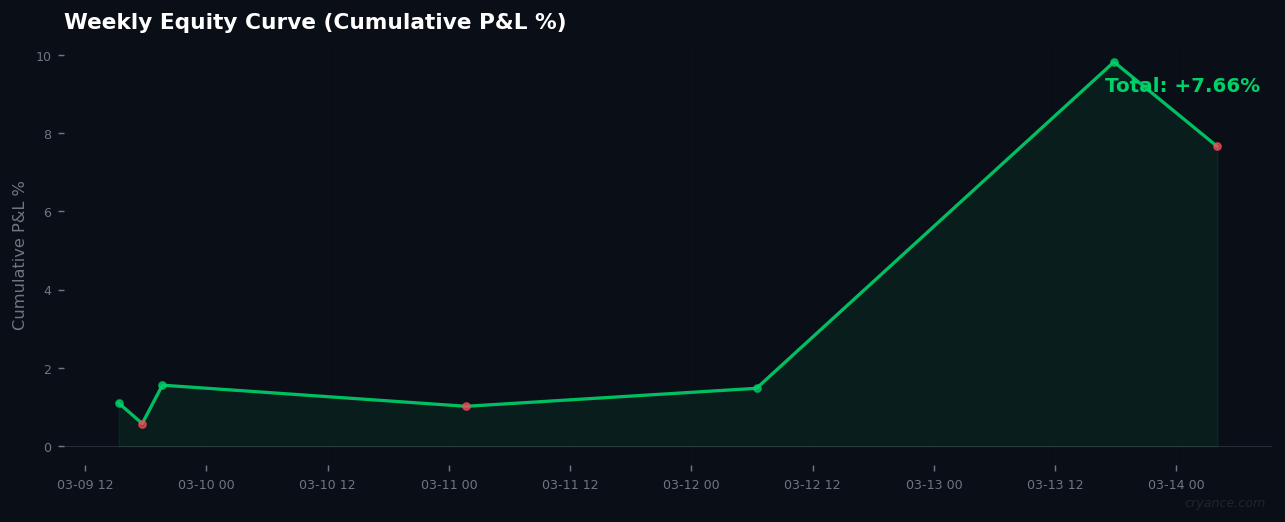
The past week in crypto markets was characterized by extreme fear and tight consolidation, as reflected in the Fear & Greed Index plunging to 16—a level indicative of panic and potential capitulation. Despite this gloomy sentiment, the trading system eked out a positive return of +7.66% across 7 trades, with a win rate of 57.1% (4 wins, 3 losses). This performance is particularly noteworthy given the dominant market regime was 'ranging,' with all 4 tracked regimes classified as such, signaling a lack of clear directional momentum. Key events included repeated tests of support and resistance in Bitcoin (BTC) and Ethereum (ETH), with stop-losses and reversal triggers playing a critical role in trade management. The week's narrative underscores a dichotomy: while AI signal accuracy was abysmal at 14.3% across all sources, disciplined risk management—evidenced by an average win of +2.72% versus an average loss of -1.07%—allowed the system to capitalize on a few high-conviction moves, primarily in BTC.
**Top Performers**
Bitcoin (BTC/USDT) was the undisputed star this week, delivering a total return of +9.44% from just two trades. The first trade was a modest LONG position that closed with a +1.10% gain after a stop-loss was hit at $68,960.40. The second trade was the week's standout: a LONG position that yielded +8.34%, closed by a stop-loss at $71,097.20. This substantial gain likely resulted from BTC briefly breaking out of its range amid extreme fear, attracting opportunistic buying. In contrast, Ethereum (ETH/USDT) underperformed with a net loss of -1.78% over five trades, though it had moments of success, such as a LONG trade that gained +0.98%. ETH's mixed performance—with two winning trades and three losing ones—highlighted its choppier price action within the ranging regime, where it faced stronger resistance around $2,030-$2,035.
**Worst Performers**
Officially, no symbols were flagged as worst performers, but Ethereum (ETH/USDT) deserves mention for its net negative contribution. The largest single loss came from an ETH SHORT position that declined -2.16%, closed by a reversal to BUY. Other ETH trades included small losses of -0.52% and -0.54%, indicating consistent pressure on the downside. However, the absence of catastrophic losses is a testament to effective stop-loss placement and position sizing, which limited drawdowns. This week, the 'worst' aspect was not a specific asset but the overall AI signal inaccuracy, which we explore next.
**AI Accuracy This Week**
All three AI sources—Rules Engine, ML Model, and LLM (Claude)—performed identically and poorly, with only 1 out of 7 trades (14.3%) correctly predicted. This low accuracy rate is alarming and suggests a significant misalignment between AI signals and actual market movements during extreme fear and ranging conditions. How, then, did the system achieve a +7.66% return? The answer lies in robust risk management protocols. For instance, the trade log shows that 4 trades were closed by stop-losses (3 hits and 1 reversal), which locked in profits or minimized losses. The largest win (+8.34% on BTC) occurred despite the AI likely not forecasting such a move, emphasizing that mechanical execution can override flawed predictions. Key lessons: First, in volatile or ranging markets, AI models may struggle with short-term noise. Second, stop-losses and reversal triggers are non-negotiable for preserving capital when signals fail. This week serves as a stark reminder that AI is a tool, not a oracle, and must be paired with stringent risk controls.
**Market Regime Shifts**
The market regime remained steadfastly 'ranging' throughout the week, with no shifts observed—the regime distribution showed {'ranging': 4} for all active symbols. This consistency implies a period of consolidation, likely as markets digest recent volatility amid extreme fear (Fear & Greed Index at 16). In such regimes, prices oscillate within defined bounds, leading to whipsaws that can frustrate trend-following strategies. The implication for trading is clear: range-bound markets favor mean-reversion tactics over breakout plays, which may explain why some AI signals (e.g., reversal trades) were triggered. However, the lack of regime diversity also signals caution; a prolonged ranging phase in extreme fear often precedes a significant breakout or breakdown. Traders should monitor volume and volatility for early signs of a regime shift, potentially to 'trending' or 'volatile,' which could alter strategy effectiveness.
**Outlook**
Based on current data, the outlook is cautiously neutral with a bias toward potential volatility expansion. The extreme fear reading (Index at 16) historically presents buying opportunities, but the persistent ranging regime suggests indecision. For AI signals, recalibration may be necessary—the 14.3% accuracy rate indicates models are not adapting well to current conditions, possibly due to overfitting on past data or missing fear-driven sentiment cues. In the week ahead, watch for BTC to hold above $70,000 for bullish confirmation or break below $68,500 for bearish momentum. ETH needs to reclaim $2,050 to regain strength. Actionable steps: First, reduce position sizes until AI accuracy improves, focusing on preserving the week's gains. Second, emphasize technical levels and on-chain data alongside AI signals for confluence. Finally, prepare for regime shifts by reviewing stop-loss parameters; a breakout from the range could lead to sharp moves. In summary, profitability this week was a win for risk management, not AI foresight, and maintaining that discipline will be key as markets navigate this fear-filled landscape.
Weekly Signal Review: Profitable Week Amid Extreme Fear and Low AI Accuracy
· MARKET · WEEKLY_REVIEW · Score: +0.0 · Regime: ranging · Sentiment: bullish
#Weekly Review #AI Analysis #Risk Management
MARKET Signals