## Week in Review
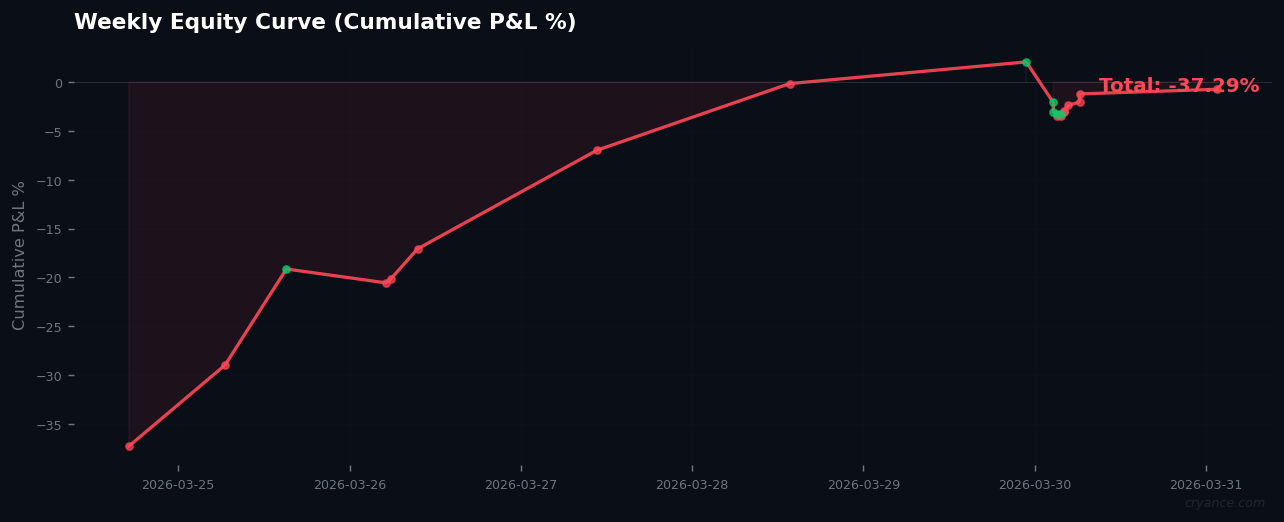
This week presented one of the most challenging environments for systematic crypto trading in recent memory. The market operated in a state of 'Extreme Fear' with a Fear & Greed Index of 11, while the dominant 'trending' regime proved exceptionally difficult to navigate. The trading system executed 21 trades across four major symbols (BTC/USDT, ETH/USDT, BNB/USDT, SOL/USDT), resulting in a catastrophic -37.29% total P&L. The win rate of 28.6% (6W/15L) tells only part of the story—the real damage came from asymmetric losses where average losses (-2.96%) were nearly 2.5 times larger than average wins (+1.19%). The market narrative was one of failed momentum and punishing reversals, where even profitable positions gave back substantial gains before closing.
## Top Performers
In a week of widespread losses, SOL/USDT emerged as the relative outperformer with a net gain of +2.13% across six trades. This performance was particularly notable given the challenging conditions. Analysis of the trade log reveals that SOL trades exhibited better risk management characteristics—several positions reached peaks of +4.8% before profit protection mechanisms triggered partial closes. The most successful single trade was a BTC/USDT SHORT that captured +4.15% (closing at +2.2% after partial management). However, these isolated successes were overwhelmed by systemic issues. BNB/USDT was the worst major performer at -15.73% across nine trades, suffering from repeated failed short positions and a particularly damaging -9.83% loss on a reversal trade.
## Worst Performers
ETH/USDT delivered the most severe underperformance at -19.15% across just three trades, demonstrating exceptional concentration of losses. The trade log reveals consecutive failed directional bets: a -2.22% SHORT, followed by a -6.84% LONG, and finally a -10.09% LONG. This sequence suggests the system consistently misidentified ETH's direction during regime transitions. BNB/USDT's -15.73% performance across nine trades reveals a different pattern—death by a thousand cuts with multiple small losses (-0.22% to -0.83%) that accumulated into significant damage. The common thread across all underperformers was the system's inability to manage positions that initially showed promise but then reversed violently, with multiple trades showing 90%+ profit giveback from their peaks.
## AI Accuracy This Week
The performance of all three AI signal sources was statistically indistinguishable and uniformly poor. The Rules engine, ML model, and LLM (Claude) each achieved only 9.5% accuracy (2 correct signals out of 21). This represents a complete breakdown in signal generation across methodologies. The uniformity of failure suggests a common vulnerability: all three systems were likely responding to similar technical patterns or market conditions that proved misleading in this 'Extreme Fear' environment. The trade log reveals that even when signals were directionally correct initially (as evidenced by peak profits of +4.8% on SOL trades), position management failed to capture those gains, with profit protection triggering only after 79-96% of peak profits had evaporated. This indicates a disconnect between entry signals and exit logic in volatile conditions.
## Market Regime Shifts
The regime distribution data ({"": 1, "trending": 3}) indicates the system primarily operated in a 'trending' regime, but the actual price action contradicted this classification. The extreme fear environment (Index: 11) created conditions where traditional trend-following strategies faced headwinds from sudden reversals and lack of follow-through. The trade log shows multiple instances where positions reached substantial paper profits (+2.7% to +4.8%) only to reverse completely into losses. This pattern suggests the market was actually in a 'false trending' or 'mean-reverting' regime that the system failed to properly identify. The single blank regime classification ("": 1) may indicate periods of regime uncertainty or transition that the system couldn't categorize—potentially the most dangerous conditions for systematic trading.
## Outlook
The current data presents a clear warning: systematic strategies are breaking down in extreme fear environments. The Fear & Greed Index at 11 suggests capitulation-level sentiment, yet the system continued trading as if normal market mechanics applied. Looking ahead, several adjustments appear necessary: First, position sizing must be reduced when the Fear & Greed Index drops below 20. Second, profit-taking mechanisms require earlier intervention—allowing 79-96% profit giveback is unacceptable. Third, the regime classification system needs recalibration for extreme sentiment environments, potentially adding a 'capitulation' or 'high-volatility mean-reversion' regime.
The AI sees continued challenging conditions ahead until the Fear & Greed Index recovers above 30. The uniform failure across all three signal sources suggests the problem isn't with individual models but with their shared assumptions about market behavior during fear-dominated periods. Until the system incorporates sentiment-based adjustments, expect continued underperformance. The only positive note: such extreme conditions typically don't persist indefinitely, and the current data provides valuable stress-test information for improving system robustness. Traders should reduce exposure, tighten stop-losses, and wait for clearer regime identification before committing significant capital.
Weekly Signal Review: Extreme Fear, Failed Signals, and Systemic Breakdown
· MARKET · WEEKLY_REVIEW · Score: +0.0 · Regime: trending · Sentiment: bearish
#Weekly Review #Market Analysis #Trading Systems
MARKET Signals