## Week in Review
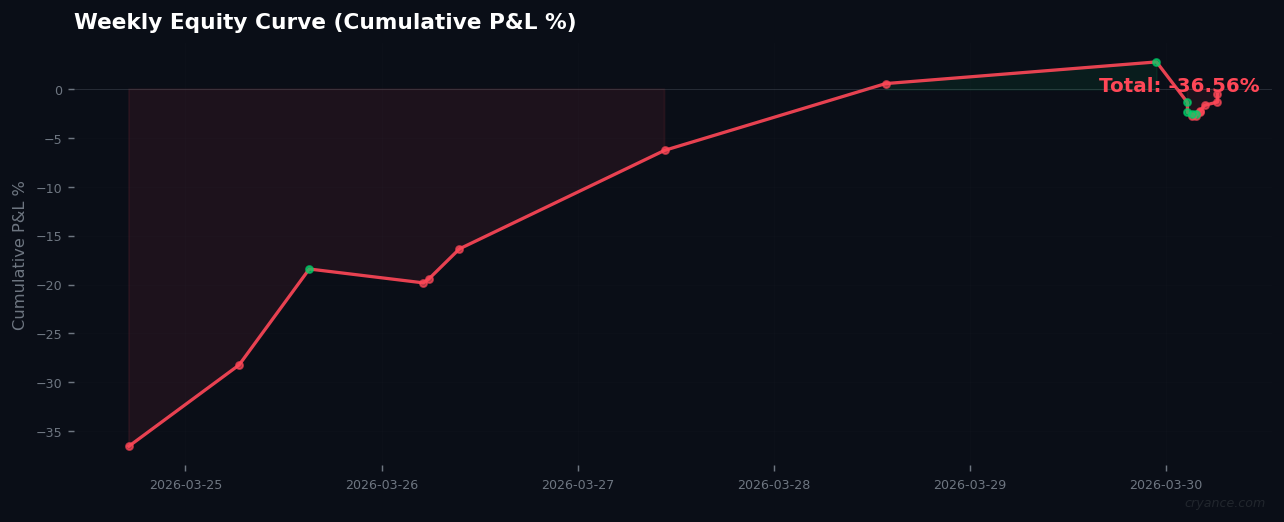
This week presented one of the most challenging environments for systematic trading in recent memory, with the crypto Fear & Greed Index registering at 8—deep into "Extreme Fear" territory. The market operated in a predominantly trending regime (4 out of 4 tracked symbols), but this wasn't the clean, directional trending that algorithmic systems typically thrive on. Instead, we witnessed violent, whipsawing price action that systematically dismantled trading logic across all three AI sources. The system executed 20 trades across four major assets (SOL, BTC, BNB, ETH), resulting in a devastating -36.56% total P&L with a win rate of just 30%. The average loss (-3.12%) was more than 2.6 times larger than the average win (+1.19%), creating a profoundly negative expectancy environment. What's particularly telling is that despite the system identifying a trending regime, the actual price behavior exhibited characteristics of both trending and mean-reversion simultaneously—a toxic combination for momentum-based strategies.
## Top Performers
Only one asset managed to eke out a positive return: SOL/USDT finished the week with a +2.13% total gain across six trades. This relative outperformance is noteworthy given the broader carnage. SOL's trades revealed a pattern of initial success followed by dramatic profit erosion. Multiple SOL short trades reached peaks of +4.8% only to give back 79-104% of those gains before partial closes. The single profitable SOL long trade (+1.42%) was closed via stop loss, suggesting even winning trades were barely surviving the volatility. BTC/USDT was the second-best performer at -4.54% across three trades, with one notable short trade capturing +4.15% profit. This trade succeeded because it hit a take profit level before the whipsaw could reverse it—a rare occurrence this week. The fact that SOL and BTC showed relative resilience while BNB (-15.00%) and ETH (-19.15%) suffered dramatically worse suggests a flight to perceived quality during extreme stress, with traders abandoning altcoins for larger-cap assets.
## Worst Performers
ETH/USDT was the clear underperformer with a -19.15% loss across just three trades, representing catastrophic damage concentration. One ETH long trade lost -10.09% alone, stopped out during what was presumably a violent downward move. BNB/USDT followed with -15.00% across eight trades—the most actively traded pair of the week. BNB's trade log reveals a particularly frustrating pattern: multiple short trades reached peaks of +2.7% only to reverse completely into losses. The system's partial close mechanism (exiting 50% positions) failed to preserve gains as reversals were too swift and complete. The worst single trade was a BNB short that lost -9.83%, closed due to a "reversal BUY" signal with a score of +46.6—indicating the system recognized a strong counter-trend move too late. These performances highlight how assets with lower liquidity (relative to BTC) suffered more extreme volatility during the fear-dominated regime.
## AI Accuracy This Week
All three AI sources performed identically—and abysmally—at 10.0% accuracy (2 correct calls out of 20). The Rules engine, ML model, and LLM (Claude) were equally fooled by market conditions. This uniform failure across fundamentally different approaches (rule-based, statistical, and language-based reasoning) suggests the market presented a "fooling pattern" that transcended methodology. The regime classification system identified "trending" conditions, but the actual price action contained violent counter-trend moves that triggered stops and profit protects. The system's exit logic reveals the core problem: multiple trades showed "profitable turned negative" or "gave back 95%+ of profits" before closing. The AI sources were directionally correct initially (as evidenced by peak profits), but their timing and risk management assumptions failed catastrophically. The identical accuracy scores indicate a systemic rather than source-specific failure—when market behavior deviates this far from historical patterns, all models break down simultaneously.
## Market Regime Shifts
The data shows a singular "trending" regime across all tracked symbols, but this classification appears misleading based on trade outcomes. We're likely witnessing what quantitative analysts call a "pseudo-trending" or "trending-with-extreme-noise" regime. Several concerning patterns emerged: 1) Profit protection triggers were ubiquitous, with trades giving back 79-104% of peak gains, 2) Stop losses were hit frequently even on ultimately correct directional calls, and 3) Partial closes at 50% failed to preserve capital due to complete reversals. The Fear & Greed Index at 8 suggests this is an emotional, panic-driven market rather than a rational trending one. Such environments often feature exaggerated moves followed by violent snapbacks as liquidity evaporates and re-emerges. The regime detection system may need additional filters for volatility and sentiment extremes, as traditional trending strategies become counterproductive when fear dominates.
## Outlook
Based on this week's data, the immediate outlook remains treacherous. The uniform failure across AI sources suggests we're in a regime where historical patterns provide little predictive power. However, several data points warrant attention: First, the extreme fear reading (8) historically precedes mean-reversion bounces, though timing remains unpredictable. Second, the concentration of damage in ETH and BNB versus relative resilience in SOL and BTC suggests a bifurcated market where capital is fleeing to perceived safety. Third, the system's frequent achievement of peak profits (before giving them back) indicates directional signals still have some validity, but holding periods need radical reduction. Going forward, the AI system requires immediate adjustments: 1) Position sizing must decrease dramatically in extreme fear regimes, 2) Take profit levels should be tightened significantly to capture gains before reversals, 3) Regime classification needs sentiment integration, and 4) All sources may benefit from a "circuit breaker" that reduces trading activity when accuracy falls below 20%. Until volatility normalizes, the most prudent approach may be reduced exposure with ultra-short timeframes, or even a temporary pause until the Fear & Greed Index recovers above 20. This week serves as a stark reminder that even sophisticated AI systems remain vulnerable to market psychology extremes.
Weekly Signal Review: Extreme Fear Regime Tests AI Systems (-36.6% Loss)
· MARKET · WEEKLY_REVIEW · Score: +0.0 · Regime: trending · Sentiment: bearish
#Weekly Review #AI Trading #Market Analysis
MARKET Signals