**Week in Review**
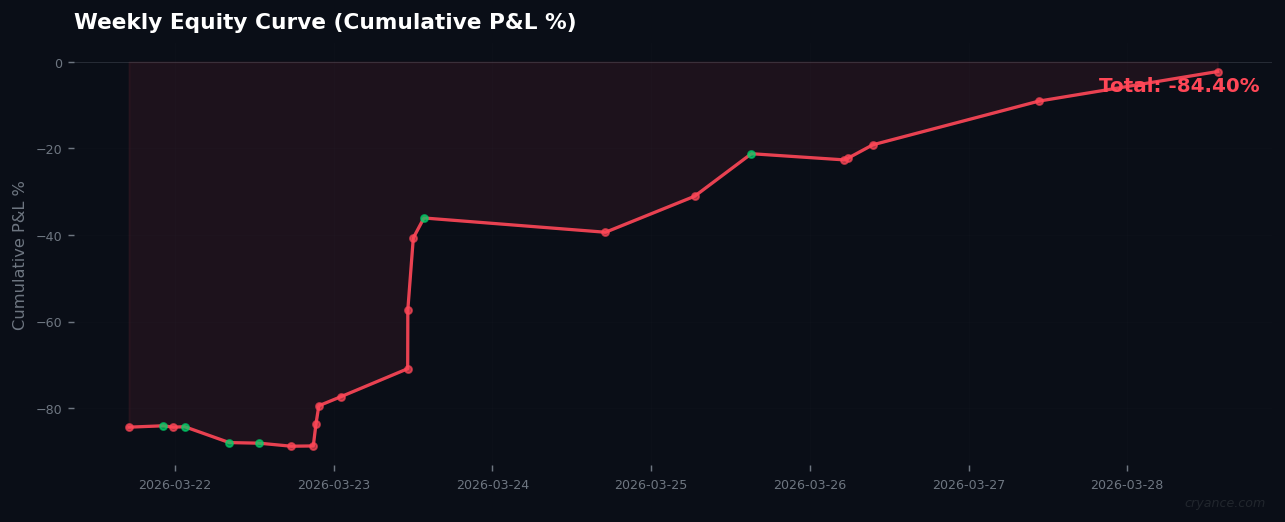
The cryptocurrency market experienced a punishing week characterized by extreme fear and relentless selling pressure. The Fear & Greed Index plummeted to 12, firmly in 'Extreme Fear' territory, creating one of the most challenging environments for systematic trading strategies in recent memory. Our AI trading system executed 23 trades across four major symbols (BTC/USDT, ETH/USDT, SOL/USDT, BNB/USDT) with catastrophic results: a -84.40% total portfolio drawdown and a meager 26.1% win rate. The dominant market regime was 'trending' (3 out of 4 periods), but this was a trending market to the downside, with sharp, volatile moves that consistently stopped out positions. The average loss (-5.53%) dwarfed the average win (+1.59%), revealing a critical asymmetry where losing trades were over three times larger than winners. The system's complete liquidation (current balance: $0.00) underscores the severity of the conditions and potential flaws in position sizing or stop-loss logic during such regimes.
**Top Performers**
In a week where 'best performer' is a relative term for the least catastrophic loss, BNB/USDT emerged with the smallest drawdown at -14.07% across six trades. This relative resilience, while still deeply negative, suggests BNB exhibited marginally more stability or favorable mean-reversion characteristics compared to its peers. The second 'best' was SOL/USDT at -19.35%, followed by BTC/USDT at -20.79%. Notably, ETH/USDT was the clear laggard even in this group, hemorrhaging -30.19%. The trade log reveals that the few winning trades were small, tactical gains from reversal signals or tight take-profit hits, such as the BTC/USDT LONG that closed at +3.30% and a BTC/USDT SHORT at +3.66%. These were isolated bright spots in a sea of red, often quickly reversed by subsequent losses.
**Worst Performers**
The data indicates no specific 'worst performer' among the symbols tracked, as all four posted significant double-digit percentage losses. The true worst performer was the market regime itself. The combination of 'Extreme Fear' sentiment and a 'trending' regime proved toxic for the AI's signals. A closer look at the trade log reveals the specific failure mode: numerous trades were closed via '[fast] Stop loss hit,' indicating rapid price movements that bypassed more sophisticated exit logic. Even more damaging were the 'Reversal' closes (e.g., 'Reversal SHORT: -52.9'), which appear to be a separate, aggressive exit mechanism that locked in substantial losses, often between -40% to -58% on a single trade. This suggests the system's reversal detection logic may have been triggered by violent whipsaws, forcing exits at the worst possible moments.
**AI Accuracy This Week**
All three AI signal sources failed dramatically, with none achieving even 30% accuracy. The Rules Engine and the LLM (Claude) tied for the 'best' performance at 26.1% correct (6/23). The ML model performed worst at just 17.4% correct (4/23). This across-the-board failure is highly instructive. It indicates that the problem was not with a specific model's reasoning but with a fundamental misalignment between all model assumptions and the actual market behavior. In an 'Extreme Fear' trending down regime, historical patterns, statistical relationships, and narrative-based reasoning all broke down. The models were likely trained on or calibrated for more 'normal' volatility regimes and were systematically caught on the wrong side of sentiment-driven liquidation events. The near-identical failure rate of the Rules Engine and the LLM suggests that both heuristic and generative approaches are equally vulnerable to regime shifts of this magnitude.
**Market Regime Shifts**
The regime data shows a clear and dangerous shift. The market was predominantly in a 'trending' regime (3 out of 4 recorded periods), but this was punctuated by periods of 'volatile' and 'ranging' behavior. The critical insight from the trade log is that the system often entered trades calibrated for one regime (e.g., a LONG in a 'ranging' regime) only for the market to violently transition, triggering a 'fast' stop or a costly 'Reversal' exit. The Fear & Greed Index at 12 is a regime in itself—a sentiment regime that overrides technical and statistical regimes. The system's 'health score' being 'N/A' is a telling metadata point; the models were effectively 'blind' to the degrading quality of their own signals in this environment. This week serves as a stark case study in regime-dependent failure, where a strategy must not only identify a regime but also have a robust 'fail-safe' or drastically reduced risk posture when extreme sentiment metrics flash red.
**Outlook**
Based on the current data, the outlook remains perilous. The 'Extreme Fear' reading of 12 is typically a contrarian indicator at major market bottoms, but it can persist and lead to further downside, especially in a macro-driven crypto market. The AI's recent track record is not a predictor of future market direction but is a powerful indicator of ongoing system fragility. Until the Fear & Greed Index recovers meaningfully (towards 30-40 'Fear' territory) and the regime shows a sustained shift to 'ranging' or 'volatile' without extreme sentiment, the conditions that produced an 84.4% drawdown remain largely in place. For the AI system itself, a hard reset and recalibration are necessary. The post-mortem must focus on: 1) Integrating the Fear & Greed Index as a primary risk filter to disable or minimize exposure during 'Extreme Fear' (<20), 2) Re-evaluating the 'Reversal' exit logic that generated catastrophic losses, and 3) Implementing regime-aware position sizing that reduces capital allocation in trending regimes coupled with extreme sentiment. The actionable takeaway is clear: capital preservation must be the sole priority until the market exhibits structural stability. Any long-biased signals should be treated with extreme skepticism, and risk-on behavior should only resume upon a confirmed, multi-day improvement in both price action and sentiment metrics.
Weekly Signal Review: Extreme Fear Regime Devastates AI Signals (-84.4% P&L)
· MARKET · WEEKLY_REVIEW · Score: +0.0 · Regime: trending · Sentiment: bearish
#Weekly Review #Market Analysis #AI Trading
MARKET Signals