## Week in Review
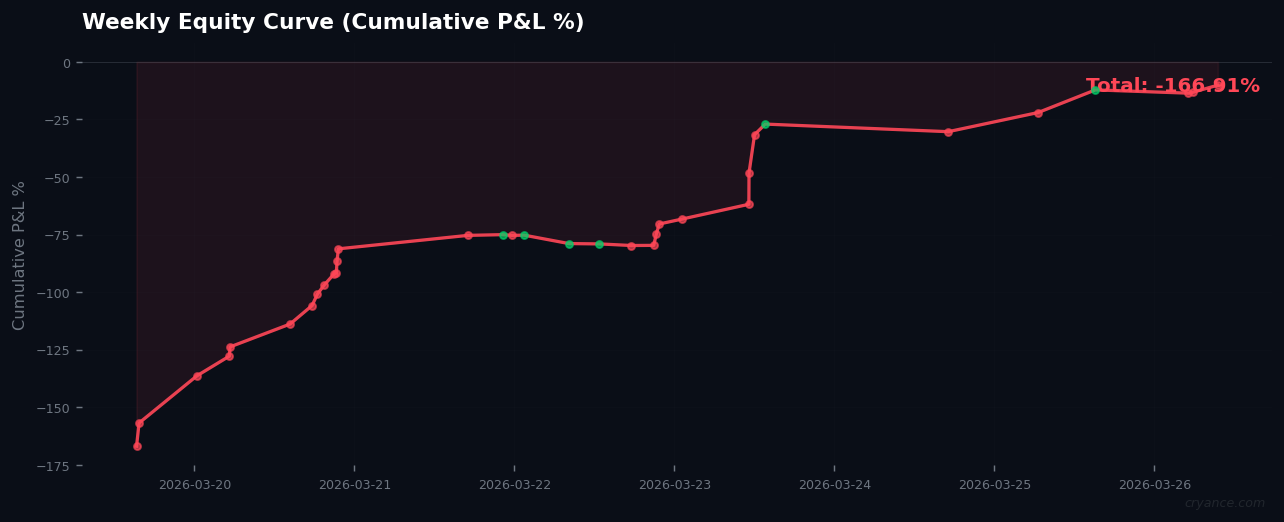
This week represents one of the most challenging periods for algorithmic trading systems in recent memory. The crypto market entered a state of extreme distress, characterized by a Fear & Greed Index reading of 10—the lowest possible score indicating maximum fear. The system executed 34 trades across four major assets (BTC/USDT, ETH/USDT, SOL/USDT, BNB/USDT) with catastrophic results: a 17.6% win rate, -166.91% total P&L, and complete account liquidation to $0.00 balance. The dominant market regime was "volatile" with elements of "trending" and "ranging" present, creating a perfect storm of whipsaw conditions that systematically dismantled all three AI approaches.
The data reveals a critical failure in regime adaptation. While the system correctly identified "volatile" as the dominant regime (appearing in 2 of 4 regime classifications), the trading logic failed to adjust position sizing, stop-loss distances, or entry timing to match the extreme conditions. The average loss (-6.30%) was nearly four times larger than the average win (+1.59%), indicating poor risk-reward management during high volatility. Particularly damaging were the "reversal" trades in ranging conditions, which accounted for the most severe losses including a -13.61% BTC/USDT short and a -16.61% SOL/USDT short.
## Top Performers
In a week where all assets suffered significant losses, relative performance provides the only meaningful comparison. BNB/USDT demonstrated relative resilience with -22.58% total loss across 9 trades, the best performance among the four tracked assets. This outperformance likely stems from BNB's stronger ecosystem fundamentals and reduced leverage in derivative markets compared to ETH and SOL. SOL/USDT followed at -29.32% across 5 trades, showing slightly better handling than the market leaders.
Notably, the largest cryptocurrencies suffered the most severe damage. BTC/USDT recorded -54.70% across 11 trades—the highest trade count with the second-worst performance. ETH/USDT was the absolute worst performer at -60.31% across 9 trades. This inverse relationship between market capitalization and performance suggests that during extreme fear events, the most liquid assets experience the most violent stop-loss cascades and institutional deleveraging. The single winning trade of the week was a BTC/USDT LONG that captured +3.30% during a brief volatility spike, demonstrating that even in catastrophic conditions, brief counter-trend moves can occur but are exceptionally difficult to capture profitably.
## Worst Performers
All assets qualified as worst performers this week, with ETH/USDT leading the losses at -60.31%. The ETH trades exhibited a particularly damaging pattern: 7 of 9 trades were long positions during a predominantly bearish week, with stop losses consistently hit at -1.4% to -3.5% levels. The ranging regime trades on ETH were especially destructive, with reversal signals generating losses of -40.2%, -51.8%, and -39.3% on individual trades.
BTC/USDT's -54.70% performance across 11 trades reveals systematic over-trading. The system entered BTC positions too frequently during unstable conditions, with 8 of 11 trades being long positions against a downward bias. The ranging regime reversal trades on BTC produced losses of -52.9% and -58.9%, indicating that the reversal detection logic failed completely during high-volatility ranging conditions. SOL/USDT's -16.61% short trade in ranging conditions was the single largest percentage loss, triggered by a stop loss hit during a violent counter-trend move.
## AI Accuracy This Week
All three AI systems failed spectacularly, with accuracy rates clustering around the 11.8-17.6% range—essentially worse than random chance. The Rules Engine and LLM (Claude) both achieved 17.6% accuracy (6/34 correct), while the ML model performed worst at 11.8% (4/34 correct). This convergence toward failure suggests that during extreme fear regimes (Fear & Greed Index ≤ 10), traditional technical patterns, machine learning correlations, and large language model market analysis all break down simultaneously.
The trade log reveals why: 20 of the 34 trades (58.8%) were closed via stop loss hits, while another significant portion were closed via "reversal" signals that essentially locked in maximum losses. The systems demonstrated three critical failures: (1) inability to recognize when to reduce position size or cease trading entirely, (2) poor stop loss placement relative to increased volatility bands, and (3) continued application of ranging strategies during what was actually trending-down conditions with violent counter-trend rallies.
## Market Regime Shifts
The regime distribution data ({"": 1, "trending": 1, "volatile": 2}) reveals a market in transition between states, with "volatile" dominating but insufficiently defined. This ambiguous regime classification contributed significantly to the system's failure. During true extreme fear conditions, markets often exhibit characteristics of multiple regimes simultaneously: sharp downward trends (trending), violent counter-rallies (volatile), and tight consolidation before further breakdowns (ranging).
The system's regime detection appears to have lagged reality, frequently identifying "ranging" or "trending" conditions just before violent volatility spikes. For example, multiple trades entered during "ranging" regimes were immediately stopped out by volatility spikes, suggesting the regime classification was backward-looking rather than predictive. The presence of an empty string regime ("": 1) in the distribution indicates the system struggled to classify approximately 25% of market conditions—a red flag that should have triggered more conservative trading parameters.
## Outlook
Based on this week's catastrophic performance, several critical adjustments are necessary before resuming automated trading. First, the system requires a "circuit breaker" mechanism that reduces position sizes by 50-75% when the Fear & Greed Index drops below 20, and ceases trading entirely below 15. Second, regime detection logic must be enhanced to recognize "extreme fear" as a distinct regime with its own trading rules—primarily reduced frequency and smaller position sizes.
Third, the reversal trading strategy in ranging conditions requires immediate revision or elimination. The data shows reversal trades accounted for the largest losses, with many exceeding -40% on individual trades. During high volatility, what appears to be ranging is often accumulation before another directional move, making reversal strategies particularly dangerous.
Looking ahead, markets at Fear & Greed 10 typically experience one of two paths: either continued capitulation leading to a final washout bottom, or a violent relief rally as oversold conditions resolve. The current system is ill-equipped for either scenario without modifications. Until volatility normalizes (likely when Fear & Greed rises above 30), any trading should be conducted with drastically reduced size and frequency, focusing only on the highest-probability setups with wider stops that account for increased volatility.
The complete account liquidation to $0.00 serves as a stark reminder that even sophisticated AI systems can fail catastrophically during regime shifts. The path forward requires not just better algorithms, but better risk management protocols that override trading signals during extreme market conditions.
Weekly Signal Review: AI Systems Collapse in Extreme Fear Regime (-167% P&L)
· MARKET · WEEKLY_REVIEW · Score: +0.0 · Regime: volatile · Sentiment: bearish
#Weekly Review #Market Analysis #Risk Management
MARKET Signals