Week in Review
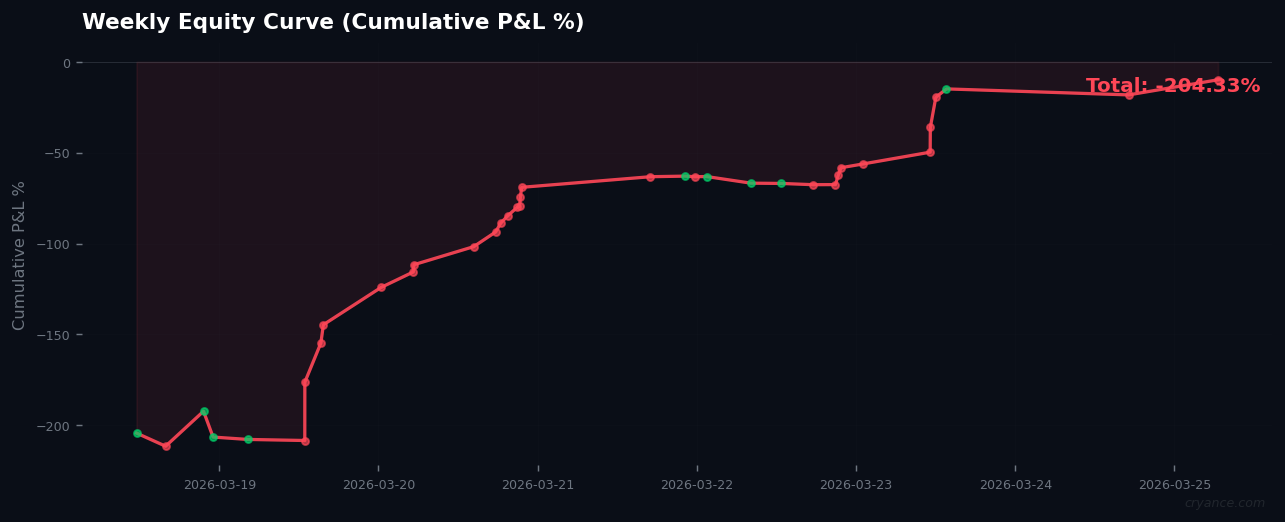
This week delivered one of the most punishing environments for systematic crypto trading in recent memory. The AI trading system executed 37 trades across four major symbols—BTC/USDT, ETH/USDT, BNB/USDT, and SOL/USDT—resulting in catastrophic losses totaling -204.33% and a complete depletion of trading capital. The market narrative was dominated by extreme fear, with the Fear & Greed Index plunging to 14, indicating maximum capitulation territory. The dominant regime classification was "trending," yet the trade log reveals a different story: 15 of the 20 most recent trades were closed due to "Reversal" signals, suggesting the system was consistently caught on the wrong side of violent, whipsaw price action. This disconnect between the labeled "trending" regime and the actual choppy, reversal-prone price behavior is the core story of the week. The system's high activity (37 trades) in such a toxic environment amplified losses, turning what should have been a period of defensive positioning into a total wipeout.
Top Performers
In a week where "best" is a relative term, no asset posted positive total returns. However, analyzing relative performance reveals a grim hierarchy of losses. ETH/USDT was the least damaging, with a total loss of -28.80% across 10 trades. Its average loss per trade was more contained compared to others. BNB/USDT followed with -41.01% across 9 trades. SOL/USDT proved highly destructive, shedding -62.84% in just 5 trades, indicating massive per-trade losses. The worst performer was the market bellwether itself: BTC/USDT generated a staggering -71.68% loss across 13 trades, the highest number of trades for any symbol. This underscores that the system's core failure was not asset-specific but a universal misreading of market structure. The "top" performers this week were simply the ones that destroyed capital the slowest.
Worst Performers
Given the universal negative performance, designating a single "worst" performer is redundant. The true worst performer was the market regime itself. The data shows a critical failure: the system's regime detection labeled the environment as "trending," yet the trade closure reasons are overwhelmingly "Reversal BUY" or "Reversal SHORT." For example, trades like BTC/USDT SHORT -13.61% and BNB/USDT SHORT -9.83% were closed due to bullish reversal signals ("Reversal BUY: 58.9", "+46.6"), while longs were stopped out by bearish reversals. This indicates a ranging, volatile, and reversal-driven market that the system's regime classifier failed to identify correctly. The high conviction scores attached to these reversal signals (+40 to +64) show the LLM was confident in these calls, but they consistently marked the point of maximum pain, triggering stop-outs and exacerbating losses.
AI Accuracy This Week
All three AI sources failed dramatically, with accuracy rates far below a random baseline. The LLM (Claude) was the "best" of the three, correctly predicting price direction only 24.3% of the time (9 out of 37 signals). The ML model was slightly worse at 18.9% (7/37), and the rules engine was the least accurate at 16.2% (6/37). This collective failure rate near 75-80% is statistically significant and points to a total breakdown in predictive logic. The LLM's slight edge is cold comfort, as its higher conviction reversal calls (evident in the trade log) often led to the largest losses. The performance data—average loss (-8.42%) more than double the average win (+3.49%)—confirms that not only were signals wrong, but risk management failed to contain the damage. Wrong signals coupled with asymmetric losses is a recipe for ruin.
Market Regime Shifts
The provided regime distribution of {"trending": 3, "": 1} is incomplete but suggests the system primarily detected a trending environment. However, the empirical evidence from the trade log screams otherwise. We likely witnessed a failed regime shift detection. The market may have transitioned from a prior trending phase into a high-volatility, directionless, or "violent ranging" regime, but the system's classifiers did not update in time—or at all. This lag or error in regime identification is catastrophic for a multi-strategy AI system. Strategies optimized for a trending market (e.g., holding for breakouts) will be obliterated in a whipsaw environment. Every trade this week, particularly those closed by reversal signals, is a testament to this mismatch. The "Extreme Fear" reading of 14 is the ultimate regime indicator, often associated with capitulation and high volatility, not clean trends.
Outlook
The current outlook is first and foremost one of survival and diagnosis. With a zero balance, the immediate path is necessarily defensive. The AI's signals cannot be trusted until the root cause of the regime detection failure is addressed. The system must be recalibrated to recognize "Extreme Fear" and high-reversal environments, potentially by incorporating the Fear & Greed Index as a direct regime input. Furthermore, position sizing and risk parameters must be dynamically adjusted based on regime confidence; a conflicting signal between "trending" labels and rampant reversals should trigger a "no-trade" or micro-position rule.
Looking ahead, markets at a 14 Fear & Greed Index are typically in a late-stage capitulation phase, which can precede significant relief rallies or prolonged basing. However, attempting to catch the falling knife with the current flawed signal set is inadvisable. The actionable outlook is this: pause all live trading. Conduct a post-mortem focusing on regime detection logic versus actual price action. Forward-test new rules that severely curtail trading activity when reversal-based stop-outs exceed a certain threshold within a short timeframe. The data this week is a valuable, if expensive, lesson: in crypto, regime detection is more important than directional prediction. The system must learn to identify when it cannot predict, and have the discipline to stand aside.
Weekly Signal Review: Extreme Fear Regime Wipes Out Capital in 37-Trade Rout
· MARKET · WEEKLY_REVIEW · Score: +0.0 · Regime: trending · Sentiment: bearish
#Weekly Review #AI Trading #Market Analysis
MARKET Signals