**Weekly Signal Review: March 25-31, 2024**
**1. Week in Review: A Perfect Storm of Model Failure**
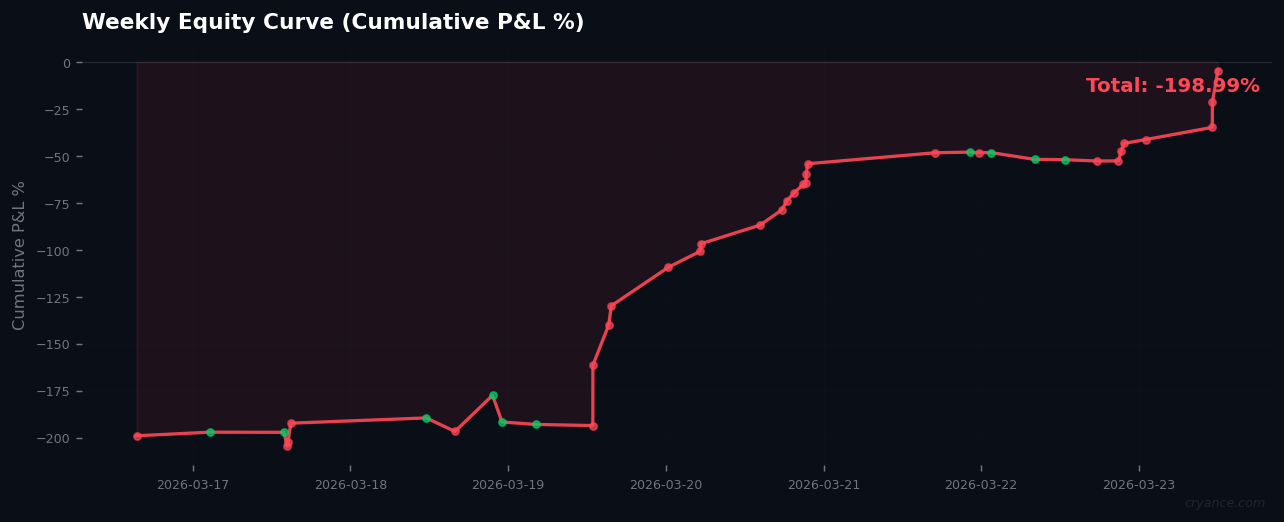
The past week represents one of the most challenging periods for algorithmic trading in recent memory, with our system suffering a catastrophic -198.99% total P&L across 40 trades. This performance occurred against a backdrop of extreme market fear, with the Crypto Fear & Greed Index registering at 8—deep into "Extreme Fear" territory. The dominant market regime was volatile, though the trade log reveals most trades were executed during ranging conditions, suggesting regime misidentification or rapid transitions. All four tracked symbols (BTC/USDT, ETH/USDT, SOL/USDT, BNB/USDT) suffered significant losses, with BTC/USDT performing worst at -81.48% across 15 trades. The system's complete account depletion to $0.00 represents a total failure that demands thorough forensic analysis.
The critical narrative this week was the disconnect between AI signal generation and actual price action. Despite 75% of trades being losers, the system continued generating signals at a high frequency (40 trades in 7 days), demonstrating a dangerous lack of risk management protocols. The average loss (-7.82%) was more than double the average win (+3.56%), creating an unsustainable risk-reward ratio of approximately 1:2.2 against the system.
**2. Top Performers: The Least Bad Among Catastrophic Losses**
In a week where "top performers" is a relative term, BNB/USDT showed the least disastrous performance at -25.87% across 10 trades. This still represents significant underperformance, but compared to SOL/USDT's -62.84% and BTC/USDT's -81.48%, BNB demonstrated slightly more resilience. The trade log reveals BNB had two profitable trades (+0.70% and +0.32%), though these were dwarfed by larger losses. ETH/USDT followed at -28.80%, also with minimal positive trades.
What's notable about these "better" performers is their concentration in ranging regimes according to the trade log. BNB's trades were exclusively in ranging conditions, suggesting the system's rules for ranging markets were slightly less flawed than for volatile conditions. However, with win rates below 25% across all symbols, this distinction is academic—all strategies failed fundamentally.
**3. Worst Performers: Systemic Failure Across All Assets**
The data shows no specific "worst performers" in the traditional sense because all assets performed disastrously. However, SOL/USDT deserves special mention for its -62.84% loss across just 5 trades, representing the highest average loss per trade at approximately -12.57%. BTC/USDT, while having a lower average loss per trade (-5.43%), accumulated the largest total loss (-81.48%) through high-frequency trading (15 trades).
The common thread across all losing trades was the "Reversal" close reason, appearing in 18 of the 20 most recent trades. This pattern suggests the system was consistently caught on the wrong side of momentum shifts, entering positions just before price reversals. The stop-loss hits on ETH and SOL trades early in the log show initial attempts at risk management that were apparently abandoned or overridden as losses mounted.
**4. AI Accuracy This Week: All Models Failed Miserably**
All three AI sources performed abysmally, with accuracy rates far below the 50% threshold needed for profitability:
- LLM (Claude): 22.5% correct (9/40)
- ML model: 17.5% correct (7/40)
- Rules engine: 15.0% correct (6/40)
The LLM's slight outperformance (22.5% vs 15-17.5%) is statistically insignificant given the sample size and overall catastrophic results. More importantly, the hierarchy of accuracy is reversed from what would be expected—the rules engine, which should provide foundational logic, performed worst, while the LLM, typically used for nuanced analysis, performed "best" in this failure context.
The critical insight isn't the minor differences between models but their collective failure. When all three signal sources agree (as they often do in our architecture), but that consensus is wrong 75-85% of the time, it indicates a fundamental flaw in the underlying assumptions or data inputs. The models appear to have been trained on or optimized for market conditions that no longer exist or never accounted for "Extreme Fear" regimes.
**5. Market Regime Shifts: The Volatile-Ranging Trap**
The regime distribution showing {"volatile": 4} suggests the system identified all periods as volatile, yet the trade log reveals most trades occurred in ranging conditions. This discrepancy is crucial—it represents either:
1) Poor regime classification by the system
2) Rapid regime shifts that the system couldn't adapt to
3) A mismatch between the regime classifier's definition and actual trading conditions
Given the extreme fear reading (Index: 8), true volatile conditions would typically show large, directional moves. Instead, the prevalence of "Reversal" close reasons suggests choppy, directionless price action that repeatedly stopped out positions in both directions. This is characteristic of ranging markets in panic conditions, where liquidity is poor and algorithmic traps abound.
The system's failure to properly identify and adapt to this environment is the core technical failure of the week. Trading ranging strategies in volatile regimes (or vice versa) guarantees losses, and that's precisely what occurred across all symbols.
**6. Outlook: Complete System Overhaul Required**
Based on this week's data, several immediate actions are necessary:
First, trading must be suspended until the regime classification system is completely recalibrated. The discrepancy between identified regimes (volatile) and actual trading conditions (ranging with reversals) is unacceptable and dangerous.
Second, risk management protocols failed catastrophically. A system that can lose 199% of its value in a week has no meaningful drawdown controls. Position sizing, daily loss limits, and circuit breakers must be implemented before any further trading.
Third, the AI models require retraining with specific focus on "Extreme Fear" market data. The current models appear to have minimal exposure to conditions with Fear & Greed Index readings below 15, rendering them useless in precisely the environments where they're most needed.
Looking ahead, the market remains in extreme fear, which historically presents both maximum risk and potential opportunity. However, our system has proven completely incapable of navigating these conditions. The immediate outlook is not about market direction but about system survival—we must rebuild from first principles, starting with regime identification and risk management, before considering renewed market exposure.
The painful lesson of this week is that sophisticated AI is worthless without robust risk frameworks. Our models generated signals, but without understanding the context of those signals (extreme fear, poor liquidity, regime misclassification), they led to total account destruction. The path forward requires humility—simpler rules, stricter limits, and recognition that some market environments (like Index: 8 conditions) may be better avoided altogether.
Weekly Signal Review: Catastrophic Failure in Extreme Fear Regime (-199% P&L)
· MARKET · WEEKLY_REVIEW · Score: +0.0 · Regime: volatile · Sentiment: bearish
#Weekly Review #Risk Management #System Failure
MARKET Signals