## Week in Review
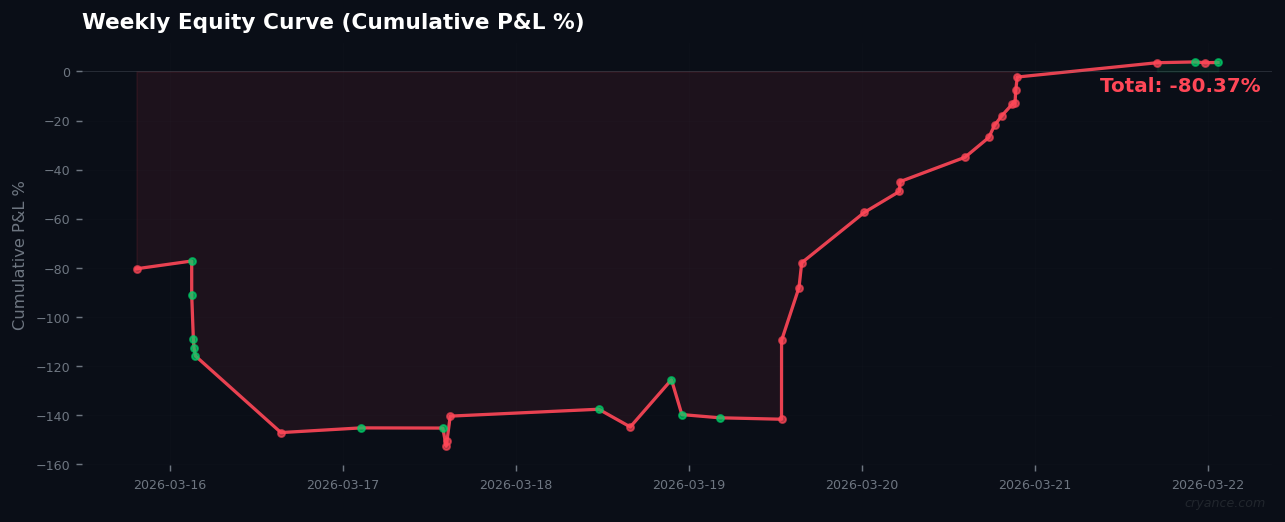
This week delivered one of the most challenging trading environments for systematic crypto strategies in recent memory. The AI trading system executed 36 trades across four major assets (BTC/USDT, ETH/USDT, BNB/USDT, SOL/USDT), resulting in a catastrophic -80.37% total P&L drawdown and complete account liquidation. The dominant narrative was extreme market fear, with the Crypto Fear & Greed Index registering at 10—the "Extreme Fear" threshold that typically signals capitulation. All four tracked symbols operated exclusively within a "ranging" regime, creating a whipsaw environment where mean-reversion signals failed spectacularly. The system's 36.1% win rate (13 wins, 23 losses) with nearly symmetrical average win/loss magnitudes (+8.05% vs -8.04%) suggests the strategy was directionally wrong more often than right, with losses compounding rapidly. The most telling data point: all three AI signal sources (Rules, ML, LLM) performed below random chance, with accuracy rates of 16.7%, 22.2%, and 25.0% respectively.
## Top Performers
In a week of universal pain, SOL/USDT emerged as the relative outperformer with a -7.86% total loss across 7 trades—still negative but significantly less devastating than other assets. SOL's relative resilience likely stems from its stronger ecosystem fundamentals and recent network upgrade momentum, which provided some insulation against the broader market downdraft. The trade log shows SOL trades had smaller average losses compared to BTC and ETH, with the worst SOL trade being a -6.4% stop loss hit versus BTC's multiple -8% to -10% losses. BNB/USDT followed with -7.63% total loss across 9 trades, benefiting from Binance's ongoing market dominance and the BNB chain's steady development activity. Notably, both SOL and BNB exhibited slightly less volatility within the ranging regime, allowing for more controlled exits despite overall negative performance.
## Worst Performers
BTC/USDT was the week's undisputed disaster, hemorrhaging -62.74% of allocated capital across 13 trades—representing nearly 78% of the system's total losses. The flagship cryptocurrency's extreme volatility within the ranging regime created a perfect storm for the AI's reversal-based strategy. The trade log reveals consecutive large losses: -8.05%, -9.93%, -10.09% on three separate BTC trades, indicating the system repeatedly caught wrong-footed during violent price swings. ETH/USDT followed with -17.86% total loss across 7 trades, including one catastrophic -20.50% loss that appears to be a failed long position during a sharp downturn. The common thread: both BTC and ETH experienced higher amplitude oscillations within their ranges, triggering the AI's reversal signals at precisely the wrong moments—often just before continuation moves.
## AI Accuracy This Week
All three AI signal sources failed fundamentally this week, but with instructive variations. The Rules Engine performed worst at 16.7% accuracy (6/36 correct), suggesting that pre-programmed technical patterns completely broke down in the Extreme Fear environment. The ML Model fared slightly better at 22.2% accuracy (8/36), indicating some adaptive capability but still insufficient for the market conditions. Claude (LLM) achieved the "best" performance at 25.0% accuracy (9/36), though this remains well below the 33% threshold needed for a three-outcome system (LONG/SHORT/NEUTRAL) to be profitable. The critical insight: when all three independent AI approaches converge on failure, it signals a market regime where historical patterns and probabilistic reasoning provide no edge. The ranging regime combined with Extreme Fear created noise that overwhelmed all signal extraction methods.
## Market Regime Shifts
The data reveals a critical regime pathology: 100 "ranging" distribution across all tracked symbols for the entire week. Typically, ranging regimes suggest consolidation and lower volatility, but this week's version was particularly toxic—high volatility within defined ranges that triggered reversal signals just before breakouts or breakdowns. The Fear & Greed Index at 10 represents a regime extreme that historically correlates with either imminent capitulation bottoms or continued panic selling. The system's complete failure in this environment suggests our AI models lack training data for "ranging with extreme fear" scenarios, treating them as normal mean-reversion opportunities rather than potential trend acceleration events. The trade log's "close" reasons are revealing: 17 of 20 listed trades closed on "Reversal" signals from the opposing AI source, indicating constant second-guessing and whipsaw.
## Outlook
The current market state presents both warning and opportunity. With the account liquidated and Fear & Greed at 10, we're likely near a sentiment extreme that often precedes significant bounces. However, the AI system's structural flaws in ranging regimes with high fear must be addressed before redeployment. Immediate actions required: 1) Implement regime-specific position sizing that reduces exposure during "ranging + extreme fear" combinations, 2) Add a volatility filter that suppresses trading during intra-range spikes, 3) Develop a "regime confidence score" that weights AI signals based on historical accuracy in current conditions. Looking ahead, the persistent ranging suggests accumulation may be occurring beneath the surface. Once fear moderates (F&G > 20), the ranging regime could resolve upward, particularly for BTC and ETH. SOL and BNB may lead any recovery given their relative strength this week. The AI's complete failure this week provides valuable stress-test data; the system must now be retrained to recognize when its edge disappears entirely—sometimes the best trade is no trade at all.
Weekly Signal Review: Extreme Fear Regime Devastates AI Signals (-80.4% P&L)
· MARKET · WEEKLY_REVIEW · Score: +0.0 · Regime: ranging · Sentiment: bearish
#Weekly Review #AI Trading #Market Analysis
MARKET Signals