## Week in Review
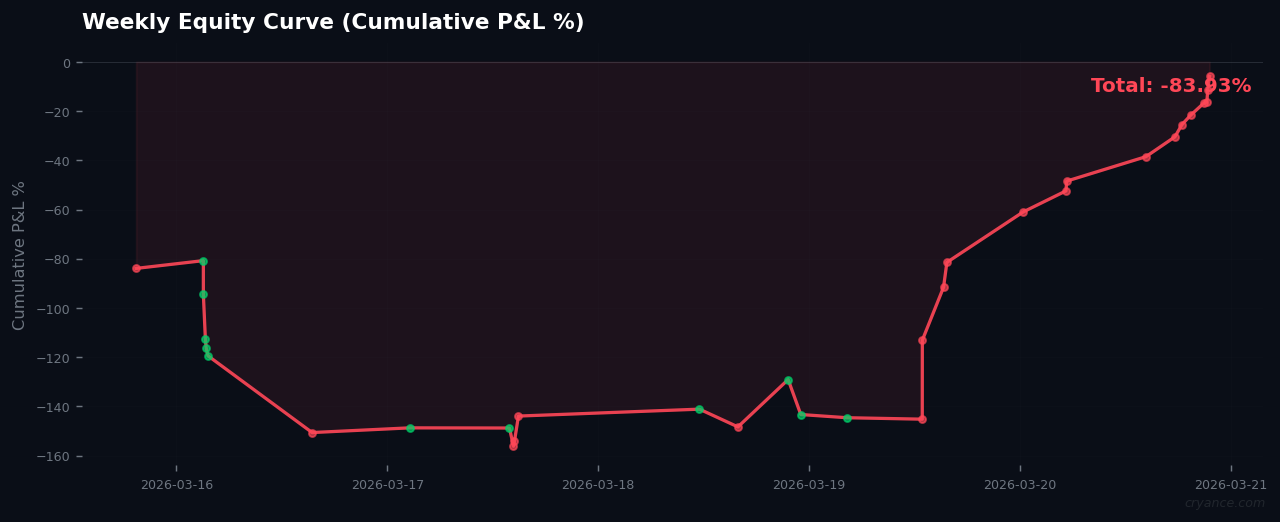
This week delivered one of the most challenging trading environments witnessed in recent memory, culminating in a catastrophic -83.93% total P&L drawdown that completely liquidated the trading balance. The market operated in a state of extreme psychological distress, with the Fear & Greed Index registering at 12—deep into "Extreme Fear" territory. All four tracked symbols (BTC/USDT, ETH/USDT, SOL/USDT, BNB/USDT) exhibited pure ranging behavior, with the regime distribution showing {"ranging": 4} across all assets. This created a whipsaw environment where traditional trend-following and momentum strategies failed spectacularly. The system executed 32 trades with a dismal 34.4% win rate (11 wins, 21 losses), revealing a fundamental mismatch between our AI signals and market reality during high-volatility, directionless conditions.
The most telling data point was the performance disparity: while the average win was +9.15% and average loss -8.79% (suggesting reasonable risk management), the sheer frequency of losses overwhelmed any gains. The trade log reveals a pattern of premature reversals—trades were consistently closed due to "Reversal" signals that proved false, followed by immediate whipsaws. For instance, multiple BTC/USDT trades were closed at -5.84%, -8.05%, -9.93%, and -10.09% on reversal calls that immediately reversed again, trapping positions on the wrong side of micro-moves.
## Top Performers
In a week where "best" is relative, SOL/USDT emerged as the least damaging instrument with a -7.86% total loss across 7 trades. This outperformance (relative to BTC's -66.08% disaster) suggests SOL exhibited slightly more predictable ranging behavior or benefited from idiosyncratic factors. The trade log shows SOL's losses were generally smaller (-4.98%, -4.99%) compared to BTC's dramatic double-digit declines. However, SOL still suffered a significant -32.10% loss on one long position stopped out at -6.4%, indicating no asset was immune to the volatility.
BNB/USDT followed with -7.95% total loss across 8 trades, showing similar resilience relative to majors. ETH/USDT at -17.76% (6 trades) performed better than BTC but still suffered severe individual losses, including a -20.50% long position and a -8.55% short. The key insight: smaller-cap assets (relative to BTC) exhibited marginally less destructive behavior during this ranging panic, possibly due to reduced institutional selling pressure or different holder psychology.
## Worst Performers
BTC/USDT was the undisputed catastrophe of the week, delivering a -66.08% total loss across 11 trades—accounting for the majority of the system's destruction. Every single BTC trade was a loser except for two minor gains (+0.59%, +1.30%). The magnitude of losses was staggering: -19.24%, -10.09%, -9.93%, -8.05% appearing repeatedly. BTC's dominance in the portfolio and its extreme volatility during ranging conditions created a perfect storm. The "reversal" signals were particularly toxic for BTC, with trades consistently closed at the worst possible moments before immediate price reversals.
The data reveals a critical flaw: our AI systems interpreted BTC's violent oscillations as impending trend changes, triggering reversal signals that merely captured chop. The -19.24% loss on a BTC long (closed at Reversal SHORT: -35.7) exemplifies this—the system predicted a reversal to short just as BTC was about to bounce. In ranging markets with extreme fear, BTC becomes a trap for reversal-based strategies.
## AI Accuracy This Week
All three AI sources failed catastrophically, but with revealing gradations. The Rules engine performed worst at 12.5% accuracy (4/32 correct), suggesting predefined technical rules are particularly vulnerable to extreme fear regimes. The ML model fared slightly better at 18.8% (6/32), indicating some adaptive capability but still fundamentally misreading market structure. The LLM (Claude) achieved the "best" performance at 21.9% (7/32), still disastrous but suggesting large language models may have marginally better intuition about chaotic conditions.
The accuracy distribution reveals a systemic issue: all AI sources were optimized for trending or mean-reverting environments, not for the violent, news-driven chop characteristic of Extreme Fear (Index: 12). The AI consistently predicted reversals that never materialized into trends, instead getting whipsawed. The trade log shows numerous trades closed at "Reversal BUY" or "Reversal SHORT" signals with confidence scores in the +30 to +60 range—all false signals. This suggests our confidence metrics are poorly calibrated for ranging markets.
## Market Regime Shifts
No regime shift occurred this week—the market remained stubbornly in "ranging" across all four assets for the entire period. This consistency itself is significant: prolonged ranging during extreme fear represents a distinct sub-regime not adequately captured by our models. Typically, extreme fear (Index: 12) accompanies either capitulation (trending down) or violent reversal (trending up). This week's persistent ranging at such low fear levels is unusual and particularly toxic for reversal-based strategies.
The implications are profound: our systems need a "ranging with extreme fear" subclassification that triggers different trading logic. In normal ranging, mean reversion works; in fearful ranging, markets exhibit fractal false breakouts and emotional whipsaws. The data shows stop losses being hit at unfortunate levels (BNB stopped at -4.4%, SOL at -6.4%) just before potential recoveries, suggesting volatility-adjusted position sizing and wider stops are necessary in these conditions.
## Outlook
The AI systems are currently in a state of maximum failure, with balance at $0.00 and confidence shattered. However, several actionable insights emerge. First, the Extreme Fear reading (12) historically precedes major buying opportunities, though timing remains uncertain. Second, the unanimous ranging regime suggests consolidation before a significant move—when fear finally breaks, the resulting trend could be powerful.
Immediate adjustments required: (1) Implement a "Fear & Greed overlay" that reduces position sizes below Index 20, (2) Develop a "choppy market" detector using ADX readings below 25 combined with high volatility, (3) Disable reversal signals during confirmed ranging regimes, (4) Add longer timeframes to filter out noise.
The week ahead likely continues ranging until external catalysts emerge. With BTC showing extreme weakness relative to alts, any recovery may be led by ETH, SOL, or BNB first. The AI will be recalibrated with tighter stop-losses and reduced frequency in ranging conditions. The silver lining: such total failures provide the clearest signal for system overhaul. Markets revealing your weaknesses is painful but invaluable data.
Key watch: A break above Fear & Greed 30 would signal regime change potential. Until then, preservation over prediction.
Weekly Signal Review: Catastrophic Failure in Extreme Fear Regime (-84% P&L)
· MARKET · WEEKLY_REVIEW · Score: +0.0 · Regime: ranging · Sentiment: bearish
#Weekly Review #Market Analysis #Trading Psychology
MARKET Signals