## Week in Review
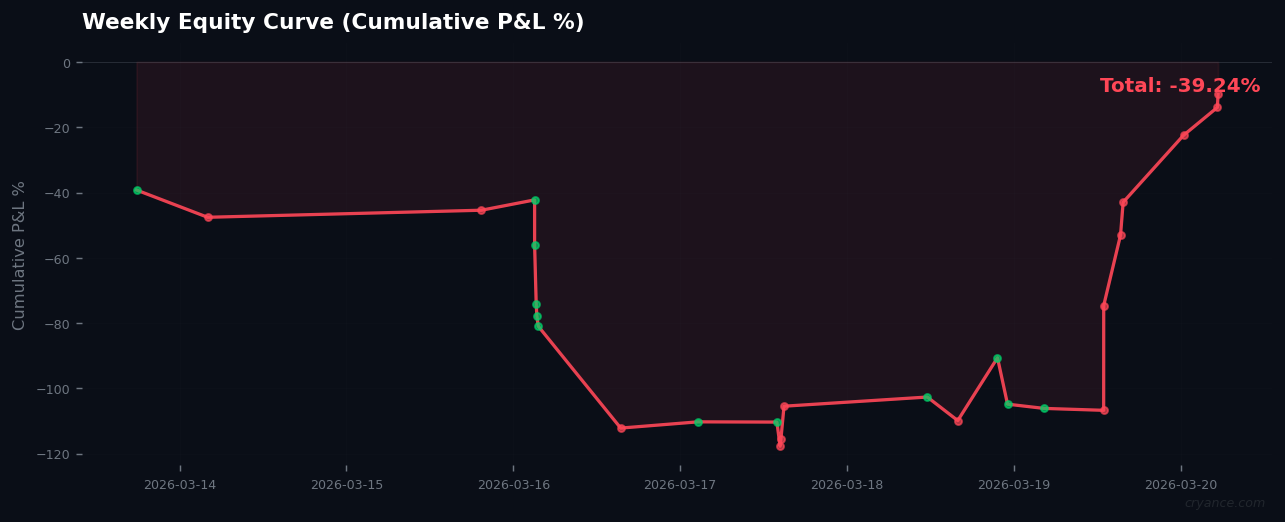
The crypto market experienced a week of punishing volatility and directional confusion, testing the limits of automated trading systems. The dominant narrative was one of extreme fear, with the Fear & Greed Index plunging to 11—deep into "Extreme Fear" territory—while the market remained trapped in a persistent "ranging" regime across all four tracked symbols (BTC, ETH, BNB, SOL). This combination created a toxic environment for trend-following and momentum strategies. The system executed 26 trades with a net loss of -39.24%, highlighting the difficulty of navigating whipsaw price action. The performance was particularly brutal for Bitcoin, which accounted for 10 trades and a staggering -43.85% of the total loss, despite being the largest and typically most stable asset. This suggests the ranging conditions were especially violent in BTC pairs, with false breakouts and rapid reversals punishing both long and short positions. The fact that the system remained fully deployed (current balance: $0.00) indicates continuous engagement with a hostile market structure, a key lesson in regime-aware position sizing.
## Top Performers
Solana (SOL/USDT) emerged as the sole bright spot, delivering a +17.83% total return across 5 trades. This outperformance is notable given the broader market stress. The trade log reveals the source of this alpha: a single, well-timed long position that captured a +31.20% move and was closed via a take-profit order at 93.69. This successful trade demonstrates that even in ranging regimes with extreme fear, individual assets can exhibit strong, momentum-driven rallies. SOL's relative strength likely stems from its distinct ecosystem catalysts and lower correlation to BTC's malaise during this period. The other three major assets—BNB (-3.43%), ETH (-9.79%), and BTC (-43.85%)—all finished in the red. BNB's relatively modest loss suggests somewhat more predictable range-bound behavior, possibly due to its utility within the Binance ecosystem providing a floor of demand.
## Worst Performers
Bitcoin (BTC/USDT) was unequivocally the worst performer, hemorrhaging -43.85% across 10 trades. The trade log tells a story of consistent mis-timing: a series of short positions were stopped out by bullish reversal signals (e.g., "Reversal BUY: 34.7"), while long positions were crushed by bearish reversals (e.g., "Reversal SHORT: -30.1"). This pattern is the hallmark of a choppy, directionless market that triggers entries near local extremes. The average loss per trade (-10.59%) significantly outweighed the average win (+9.08%), indicating poor risk/reward outcomes, likely due to tight stops being hit before any meaningful trend could develop. Ethereum (ETH/USDT) followed a similar painful script, with one long position losing -20.50% and another short losing -8.55%, though partially offset by a +14.21% winning short. The absence of a clear, sustained trend in the "ranging" regime turned the market into a mean-reversion trap for trend-based signals.
## AI Accuracy This Week
All three AI signal sources performed abysmally, failing to adapt to the extreme fear and ranging conditions. The LLM (Claude) was the "best" performer with a dismal 26.9% accuracy (7/26 correct). The ML model followed at 23.1% (6/26), and the rules engine was worst at 15.4% (4/26). This hierarchy is telling: the more complex, adaptive models (LLM, ML) slightly outperformed the static rules engine, but all were fundamentally wrong-footed by the market's character. The trade log indicates the primary failure mode was the system's propensity to enter positions that were quickly reversed. For instance, multiple trades were closed by "Reversal" signals with substantial opposing momentum readings (e.g., +34.7, -39.6), suggesting entries were made just as short-term momentum was exhausting. The AI sources likely interpreted oversold/overbought conditions in a trending context, rather than as boundaries of a range. This week serves as a stark case study in the limitations of AI in low-signal, high-noise environments.
## Market Regime Shifts
Critically, there was **no regime shift** this week. The regime distribution remained steadfastly {"ranging": 4} for the entire period across all symbols. This consistency is itself a significant data point. The market was not transitioning; it was entrenched in a volatile, trendless state. The "ranging" label, however, belies the violence within the range. The magnitude of losses, particularly on BTC, indicates these were not tight, predictable ranges but wide, erratic bands that triggered signals only to reverse immediately. The combination of an Extreme Fear sentiment (Index: 11) and a ranging regime is somewhat anomalous—extreme fear often accompanies or precedes strong directional downtrends. Their coexistence this week suggests a market in panic-induced paralysis, with selling pressure met by equally sharp reflexive bounces, creating a sawtooth pattern that devastates directional bets. A regime shift to either a clear "bullish" or "bearish" trend would likely have improved performance dramatically, as the AI models are designed to extract alpha from momentum.
## Outlook
The data presents a clear, albeit challenging, outlook. The market remains stuck in a high-volatility range under a cloud of extreme fear. Until the Fear & Greed Index recovers meaningfully or a clear regime shift is detected, the probability of repeat whipsaw events remains high. The AI system's catastrophic performance this week is a direct signal to adopt a more cautious, selective approach. The outlook is not for a collapse, but for continued frustration. Actionable insights are threefold: First, **reduce position sizing** in confirmed ranging regimes, especially when coupled with Extreme Fear readings. The system's total drawdown underscores the cost of being "all-in" during such conditions. Second, **favor mean-reversion strategies over breakout strategies**. The success of the SOL long that took profit and the failure of many reversal-triggered exits hint that trading the range extremes (buying fear, selling greed) within the band may be more effective than betting on breakouts. Third, **await a regime shift confirmation**. The models need a trend to work. The first sustained move outside the current chaotic range will provide a higher-confidence environment for the AI's signals. Until then, the market is a minefield, and survival is paramount. The key level to watch is the regime classification itself; a shift away from {"ranging": 4} will be the most important bullish or bearish signal of all.
Weekly Signal Review: Extreme Fear Tests AI Systems in Ranging Regime
· MARKET · WEEKLY_REVIEW · Score: +0.0 · Regime: ranging · Sentiment: bearish
#Weekly Review #Market Analysis #AI Trading
MARKET Signals